
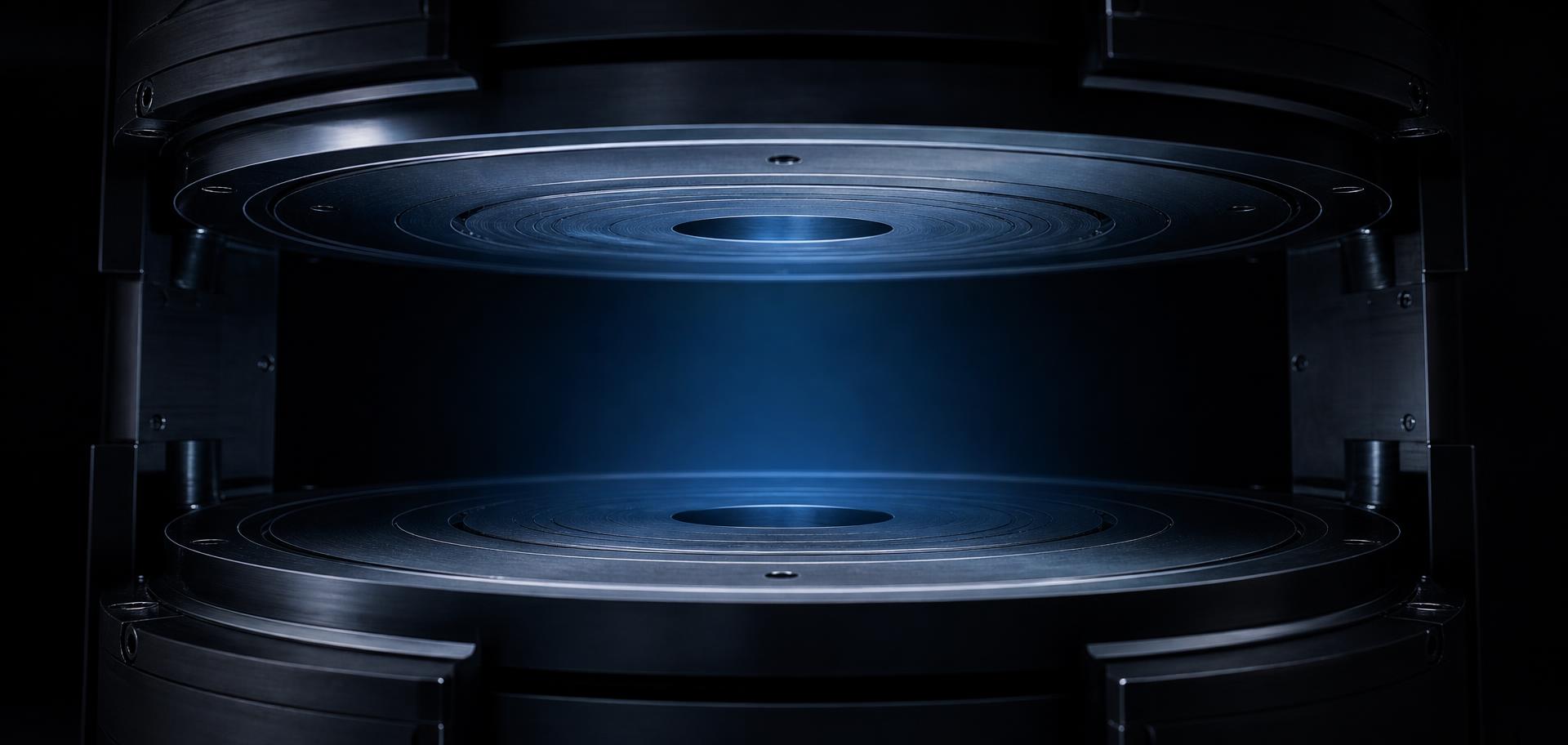
Matter, shaped by fields.
Using recent breakthroughs in holographic metamaterials, this machine shapes acoustic and electromagnetic fields on the boundary of its build chamber. Matter is moved and fused into place by those fields — not by tools, nozzles, or molds. The same fields can be read back out as a scan, so the machine writes and records at the same time.
Two chambers, one closed loop.
The machine holds a storage chamber for raw material and a build chamber where the object appears. Acoustic and electromagnetic fields do all the work between them: they identify what a grain is, move it, and change its energy state so it bonds where it lands. Nothing reaches in — the fields are the only actuator.
A print file is a holographic pattern, written in both the ultrasound and the electromagnetic spectrum. Printing is a closed loop: move material, listen to the chamber's resonant response, compare it to the pattern, correct, repeat. The object is finished when the chamber answers exactly like the file says it should.
No more printing in layers.
Layer-by-layer is a constraint of the tool, not the material. Here the fields reach into the whole volume at once, so an object is built in all places at the same time — not swept from bottom to top. What sets the time is the work of aligning and fusing matter to the pattern, not how big the object happens to be. Four kinds of field share that work, each doing the one job it is best at.
Ultrasound moves things. It picks a grain out of the stock, carries it across the chamber and holds it where the pattern says it belongs — pushing matter with pressure, never with anything that touches.
Light forms optical tweezers — a radiation-pressure grip fine enough to place material at the resolution of biology. It is also the machine's eye: every instant of building is also a measurement.
Microwaves pass straight through the object and deposit warmth only where the pattern is tuned to absorb it. That is how a bond is made deep inside a solid — no torch, no surface, no waiting for heat to travel inwards.
Metals answer to magnetism directly. Coils in the boundary lift, ferry and melt conductive material without contact, giving the machine a grip on the heavy, opaque stock that sound and light handle less well.
Five chapters, one machine.
Everything below is drawn from our research papers — each chapter links to the papers behind it, so you can go exactly as deep as you want.
Start with the machine.
Two chambers — one holds the object, one holds the matter it will become. Between them, one plate.